
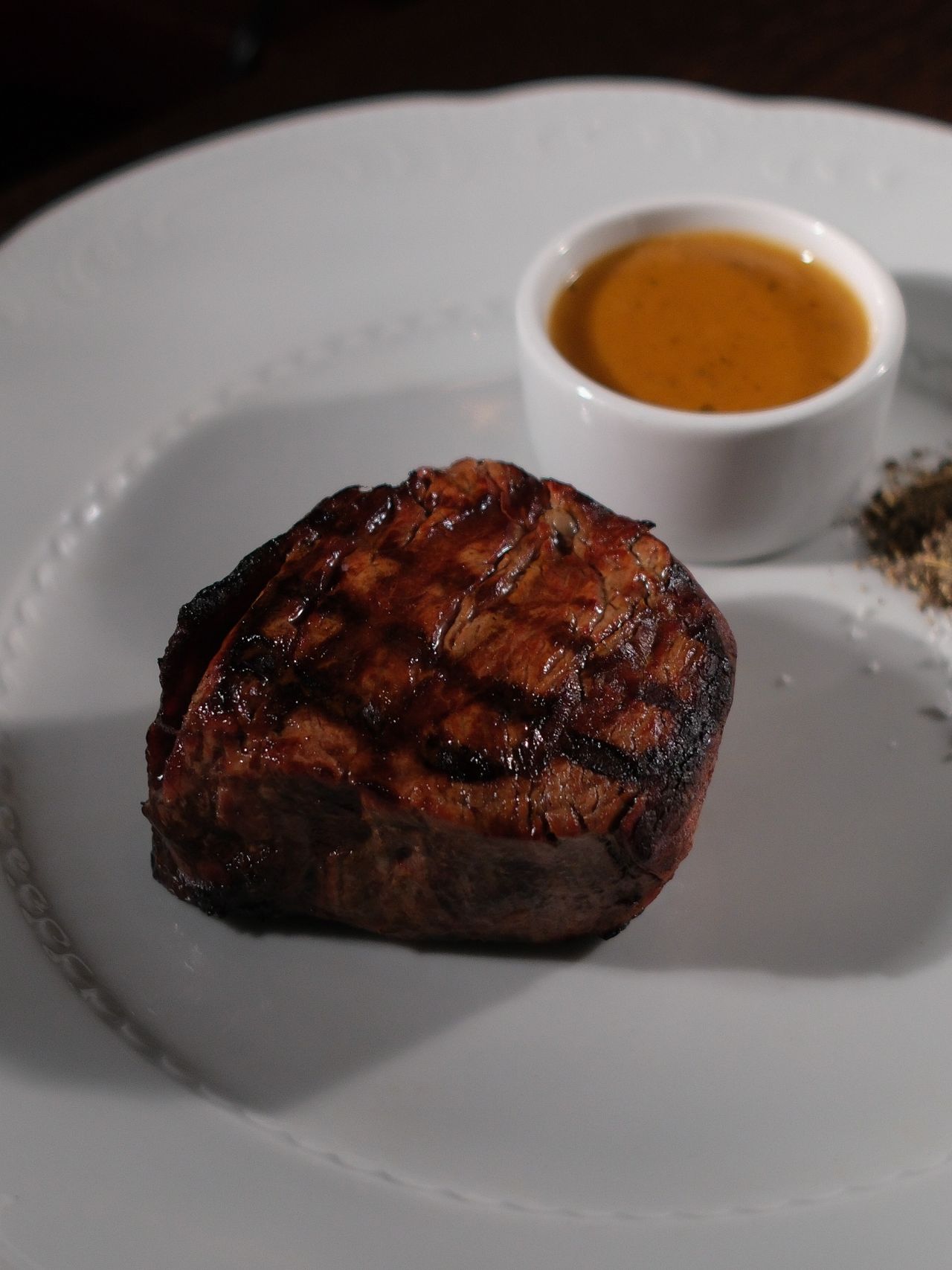
Steak au poivre without cognac isn’t a compromise — it’s the same dish built on a different pan-sauce base. The peppercorn crust and the searing technique are the same. What changes is the deglaze: instead of brandy, you use rich beef stock plus balsamic vinegar to build the acidic, umami-forward liquid the cream sauce needs. The result is silky, glossy, and reads as classic French bistro — safe for kids, halal-friendly, and just as good as the alcohol version. Twenty minutes end to end, one skillet, restaurant-quality result.
The short answer: Press two thick filet or NY strip steaks into coarsely cracked black pepper and salt. Sear in a very hot skillet with butter and oil, 3 minutes per side for medium-rare. Rest the steaks. Deglaze the pan with beef stock and balsamic vinegar, reduce, add heavy cream and Dijon, mount with cold butter. Spoon over the steaks. No alcohol, same French bistro flavor.
What’s in this guide
Why the No-Alcohol Version Actually Works
Traditional steak au poivre uses cognac to deglaze — its role is threefold: acidity to lift the pan fond, sugar to caramelize, and umami-rich compounds to build depth. All three functions can be reproduced with pantry ingredients.
| What cognac contributes | Alcohol-free replacement |
|---|---|
| Sharp acidity to deglaze | Balsamic vinegar (1 tbsp) |
| Umami depth and body | Rich beef stock (¼ cup) |
| Caramelized-sugar backbone | Dijon mustard (1 tsp) + the balsamic’s natural sugars |
| Aromatic warmth | Extra shallot + fresh crushed pepper from the pan |
The four together do everything cognac does, minus the ethanol. Because the peppercorn crust is what dominates the palate anyway, the swap is nearly invisible at the table.
Best Cut of Steak
Filet mignon (most classic)
The traditional Normandy choice. Tender, lean, no chew — the pepper crust and cream sauce carry all the flavor. Cut 1.5 to 2 inches thick. About 6 to 8 oz per person.
New York strip (best flavor)
Beefier flavor than filet, still tender enough for high-heat searing. Better marbling, more depth. Cut 1 to 1.5 inches thick. Also 6 to 8 oz per person.
Ribeye
Works well if you love fat. Slightly harder to sear evenly because of the marbling variation. Trim the outer fat cap slightly so the crust adheres.
Skip: sirloin, flank, skirt
Too lean for the technique — they’ll cook through before you get a proper crust. Steak au poivre needs a thick, tender cut that can handle hard heat.
The Peppercorn Rules
The pepper is not a seasoning — it’s the whole dish. Three rules make or break the crust:
Rule 1: Fresh whole peppercorns only. Not pre-ground pepper from a jar. Whole Tellicherry, Malabar, or Sarawak peppercorns are traditional. Buy them whole and crack them yourself the day of cooking.
Rule 2: Coarse, never fine. Use a mortar and pestle, or crush with the bottom of a heavy pan on a cutting board. You want cracked pieces the size of coarse sea salt — big enough to form a crust, not a dust. A pepper mill on the coarsest setting works if you have nothing else.
Rule 3: Press the pepper in, don’t sprinkle. Coat both sides of each steak generously (about 1 tbsp per steak), then press hard with the flat of your hand so the peppercorns embed in the meat. If they fall off during searing, you didn’t press hard enough.
The Alcohol-Free Sauce Formula
Every alcohol-free steak au poivre recipe online swaps the cognac for one thing — usually just beef broth. That single-ingredient swap flattens the sauce. Cognac contributes acidity, umami, AND caramelization — three functions no single juice covers. You need a mix.
The formula for the deglaze (per 2 steaks):
- ¼ cup rich beef stock — body and umami
- 1 tbsp balsamic vinegar — acidity and sweetness
- 1 tsp Dijon mustard — tang and emulsifying power for the cream
Everything else in the sauce (shallot, heavy cream, cold butter) stays exactly as it is in the classic. The three ingredients above are what replace the cognac cleanly.
Ingredients You’ll Need
The steaks
- 2 filet mignon or NY strip steaks, 6–8 oz each, 1.5 inches thick
- 2 tbsp whole black peppercorns, coarsely cracked
- 1 tsp coarse sea salt or kosher salt
For searing
- 1 tbsp neutral oil (grapeseed or avocado)
- 2 tbsp unsalted butter
The alcohol-free sauce
- 1 large shallot, finely minced
- ¼ cup rich beef stock (concentrated)
- 1 tbsp balsamic vinegar
- 1 tsp Dijon mustard
- ½ cup heavy cream
- 2 tbsp cold unsalted butter, cubed (for mounting)
- Salt to taste
To garnish
- Fresh parsley, chopped
- Extra cracked pepper for the plate
Step-by-Step: How to Make Alcohol-Free Steak au Poivre
- Temper the steaks. Pull the steaks from the fridge 45 minutes before cooking. Pat completely dry with paper towels. Season all over with the sea salt — no pepper yet.
- Crush the peppercorns. Place the whole peppercorns in a mortar and pestle. Crush to a coarse crack — big pieces, not powder. Alternately, put them in a zip-top bag and smash with the bottom of a heavy skillet.
- Coat and press. Spread the cracked pepper on a plate. Press each steak firmly into the pepper on both sides, coating fully. Really press — you want the peppercorns to stick to the meat, not brush off in the pan.
- Heat the pan hot. Set a heavy skillet (cast iron or stainless steel) over high heat for 3 minutes until it’s smoking hot. Add the neutral oil and swirl. When the oil shimmers and just starts to smoke, add 1 tbsp of butter.
- Sear the steaks. Lay the steaks in the pan, away from you. Don’t touch them for 3 minutes for medium-rare (a 1.5-inch filet). Flip once, cook another 3 minutes. Add the remaining 1 tbsp butter to the pan and baste the steaks by tilting the pan and spooning the melted butter over the tops for 30 seconds.
- Rest the steaks. Transfer the steaks to a plate. Cover loosely with foil. Rest for 5 minutes minimum — this is where the internal temperature evens out and juices redistribute. Do not skip.
- Bloom the shallot. Return the pan to medium heat (still with the residual butter and peppercorn fond). Add the minced shallot and cook for 90 seconds until softened and translucent.
- Deglaze without alcohol. Pour in the beef stock and balsamic vinegar. Scrape the bottom of the pan with a wooden spoon to release all the peppercorn fond. Let the liquid reduce by half, about 90 seconds.
- Add cream and Dijon. Whisk in the heavy cream and Dijon mustard. Simmer for 2 to 3 minutes at a gentle bubble (never a boil) until the sauce coats the back of a spoon. Taste for salt.
- Mount with cold butter. Off the heat, whisk in the cold cubed butter, one piece at a time, until the sauce turns glossy and thick. This is monter au beurre — the technique that makes the sauce restaurant-glossy.
- Plate and pour. Place a rested steak on each warm plate. Spoon the peppercorn cream sauce generously over the top. Shower with chopped parsley and a light dusting of extra cracked pepper. Serve immediately.
▶ Watch: the technique (adapt with the alcohol-free deglaze)
Note: the video uses cognac. When you cook the recipe above, replace the cognac with ¼ cup beef stock + 1 tbsp balsamic vinegar as the deglazing liquid. Everything else in the technique is identical.
Doneness Chart and Internal Temperatures
Steak au poivre is traditionally served rare to medium-rare — anything more cooked and the pepper crust dominates the palate. Use an instant-read thermometer for precision. Pull the steaks 5°F before target because they’ll continue cooking during the rest.
| Doneness | Pull temp | Final temp after rest | Time (1.5″ filet) |
|---|---|---|---|
| Rare | 115°F / 46°C | 120°F / 49°C | 2 min per side |
| Medium-rare (traditional) | 125°F / 52°C | 130°F / 54°C | 3 min per side |
| Medium | 135°F / 57°C | 140°F / 60°C | 4 min per side |
| Medium-well | 145°F / 63°C | 150°F / 66°C | 5 min per side |
| Well done (not recommended) | 155°F / 68°C | 160°F / 71°C | 6+ min per side |
Variations (All Alcohol-Free)
Green peppercorn version
Use whole brined green peppercorns instead of dried black. Milder heat, more herbal flavor. Add 2 tbsp of the brined peppercorns directly into the cream sauce. Different flavor profile, same technique.
Mixed peppercorn crust
Combine black, white, green, and pink peppercorns (equal parts) for a more complex crust. Pink adds fruit notes; white brings earthy pungency. Modern French home-cooking twist.
Cream-and-mushroom variant
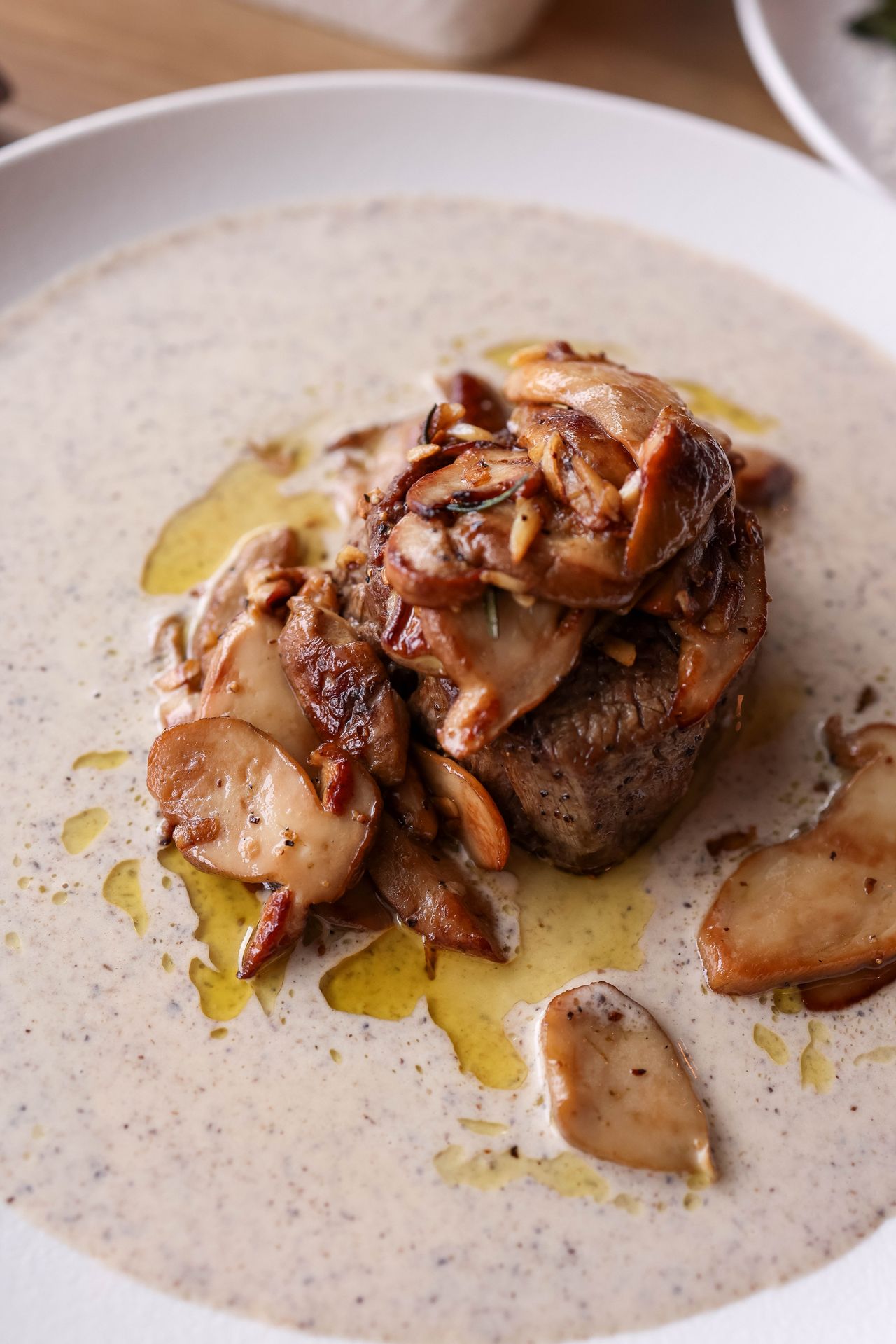
Sauté 4 oz sliced cremini mushrooms in the butter before adding the shallot. Adds body and umami. Widespread in modern French bistros, still fully alcohol-free.
Grape-juice-forward deglaze
Alternative alcohol-free deglaze: replace the balsamic with 2 tbsp red grape juice + 1 tsp red wine vinegar. Slightly fruitier, closer to the flavor profile of the original brandy version.
What to Serve With Steak au Poivre
Pommes frites
Twice-fried French fries. The classic bistro pairing — steak-frites is the French national dinner. Cut them thin (allumettes) and fry once at 300°F, then again at 375°F for crisp.
Pommes purée
Silky French mashed potatoes — Joël Robuchon-style, roughly equal weights potato and butter. The sauce pools beautifully in a well of hot mash.
Haricots verts
Thin French green beans, blanched and tossed with butter and shallots. Bright, sharp, keeps the plate looking bistro-French.
Simple green salad
Butter lettuce with a Dijon-shallot vinaigrette. Served after the steak, French bistro style. Palate reset before dessert.
Five Mistakes That Ruin Alcohol-Free Steak au Poivre
Storage and Reheating
Common Questions
Can steak au poivre really be made without cognac?
Yes — and the difference at the table is minimal. Cognac’s role in the sauce is acidity, umami, and caramelization. Beef stock + balsamic vinegar + Dijon mustard covers all three functions. The peppercorn crust dominates the palate anyway, so the sauce swap is nearly invisible in the final dish.
What’s the best cut for steak au poivre?
Filet mignon is the traditional Normandy choice — tender, lean, lets the pepper crust and cream sauce shine. New York strip is a more flavorful alternative with slightly more chew. Cut 1.5 inches thick minimum, 6 to 8 oz per person. Skip lean cuts like sirloin or flank — they can’t handle the high-heat sear.
Do I still need Dijon in the alcohol-free version?
Yes — even more than in the classic version. Dijon does two things here: adds tangy depth that cognac normally provides, and emulsifies the cream sauce so it stays glossy instead of splitting. Use a proper French Dijon (Maille or Grey Poupon), not yellow ballpark mustard.
Why did my sauce break or turn grainy?
Two likely causes: you boiled the cream (should simmer, not boil), or the pan was too hot when you added the butter at the end (mount off the heat, never on it). To fix a broken sauce, whisk in 1 tbsp cold cream and remove from heat immediately — usually saves it.
How thick should the steaks be?
Minimum 1 inch, ideally 1.5 to 2 inches. Thinner steaks overcook by the time the pepper crust forms; thicker steaks need finishing in the oven. For a 1.5-inch filet, 3 minutes per side over high heat gets you a proper medium-rare with a beautiful crust.
Can I use vegetable stock instead of beef?
You can, but the sauce will be noticeably lighter and less deep. If beef stock isn’t an option, use a rich mushroom stock or a combination of vegetable stock plus 1 tsp soy sauce for umami depth. Chicken stock is too mild for the pairing — beef flavor supports beef flavor.
Loved this recipe?
Explore more French classics and steak techniques from around the world.
See more recipes →
Steak au Poivre Without Alcohol: French Recipe (No Cognac)
A French bistro-style steak dish with a peppercorn crust and cream sauce, made without cognac
- 2 filet mignon or NY strip steaks 6-8 oz each, 1.5 inches thick
- 2 tbsp whole black peppercorns coarsely cracked
- 1 tsp coarse sea salt or kosher salt
- 1 tbsp neutral oil grapeseed or avocado
- 2 tbsp unsalted butter
- 1 large shallot finely minced
- 1/4 cup rich beef stock concentrated
- 1 tbsp balsamic vinegar
- 1 tsp Dijon mustard
- 1/2 cup heavy cream
- 2 tbsp cold unsalted butter cubed
- fresh parsley chopped
- extra cracked pepper
Step-by-Step
Temper the steaks
Crush the peppercorns
Coat and press the steaks
Heat the pan hot
Sear the steaks
Rest the steaks
Bloom the shallot
Deglaze without alcohol
Add cream and Dijon
Mount with cold butter
Plate and pour
- heavy skillet
- mortar and pestle
- cutting board
Traditional steak au poivre without cognac, using beef stock and balsamic vinegar for the deglaze
Did You Try Our Recipe ?
Scrumptious
My husband (who is extremely picky) loved the liver & onions so much!! I didn’t have any beef broth or Sherry so I used about a tbl of Worcestershire and 1/4 c of white wine …..it was scrumptious
Response from MeatRecipesBox
Oh wow, I’m so happy to hear that!! 😍 I love that you made it work with what you had on hand — Worcestershire and white wine sound like a delicious twist. So glad your husband enjoyed it, especially being picky! Thank you for sharing your version, it makes me smile knowing it turned out scrumptious!
This was amazing
This recipe turned out really amazing! It’s juicy and spiced deliciously. I definitely would use less of the spicy pepper next time, but it really was delicious and I don’t think I’ll make chicken legs any other way from now on.!
Response from MeatRecipesBox
Thank you for taking the time to leave such a thoughtful review. I’m really glad to hear the recipe turned out juicy and full of flavor for you. That’s exactly what I was hoping for when putting it together. Good call on the spicy pepper as well. Adjusting the heat level to your own taste is always the best approach, and using a little less next time should make it just right for you. I really appreciate you trying the recipe and sharing your experience. It’s great to know it worked so well for you.
I Didn’t Expect This Cornbeef Hash Recipe to Taste This Good!!
One skillet. A handful of simple ingredients. Thirty minutes on the clock. And somehow… I ended up with the crispiest, most comforting cornbeef hash recipe I’ve made in years.
I wasn’t expecting much—just a quick, no-fuss meal. But that first bite? Crispy edges, tender potatoes, smoky corned beef, a little kick of pepper. It tasted like something straight off a cozy diner griddle.
Honestly, it caught me off guard—in the best way. Here’s why this simple skillet completely won me over.


