

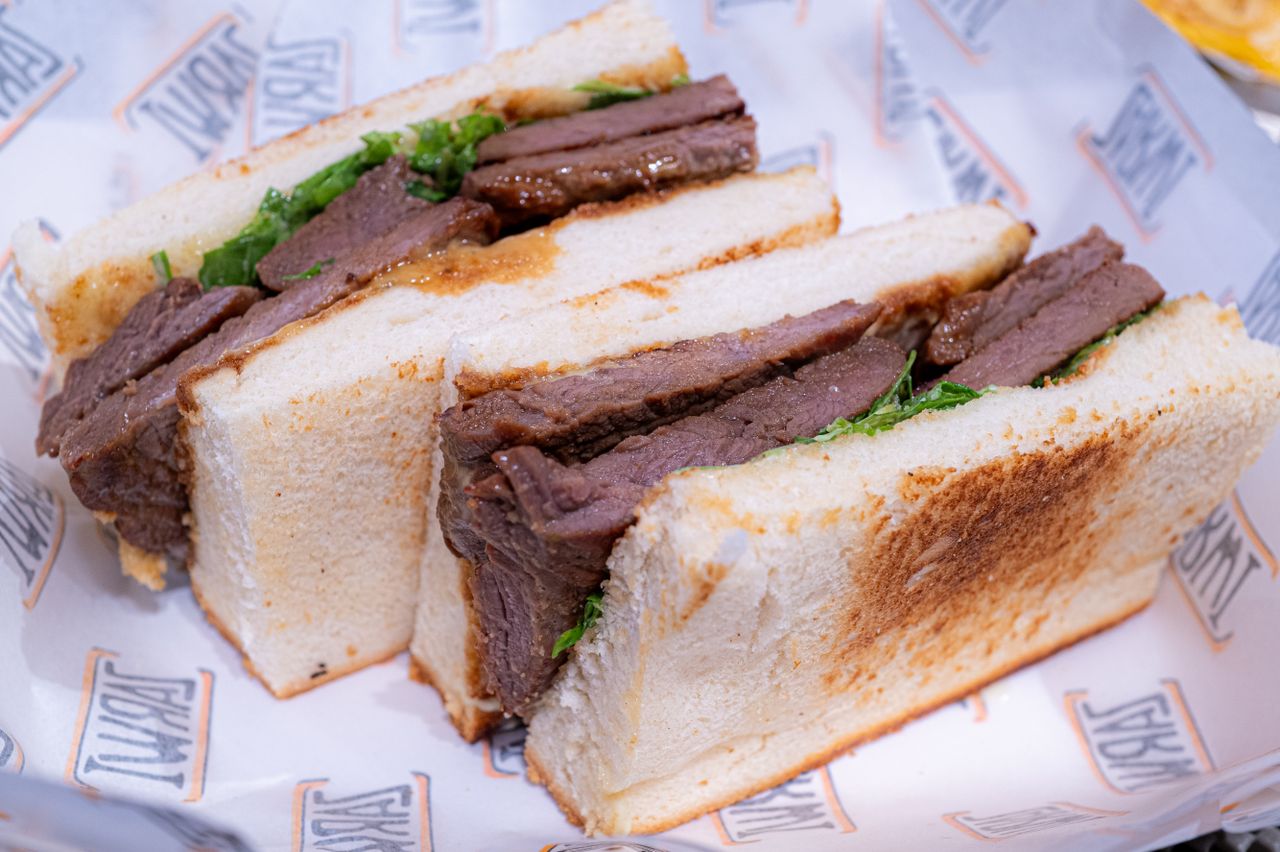
The French dip sandwich is a Los Angeles invention with a misleading name — there’s nothing French about it beyond the roll. Two downtown LA delis, Cole’s and Philippe’s, have argued for a century over who created it, but the sandwich itself is dead simple: thinly sliced roast beef piled on a soft-crusted French roll, served with a small cup of hot beef au jus for dipping. That’s the whole dish. Get the beef pink and thin, get the au jus deeply beefy, and the sandwich takes care of itself. This guide walks through both the from-scratch roast method and the deli-beef shortcut, plus how to build a real au jus without a mix packet.
The short answer: Season a top round or sirloin tip roast, sear, roast at 325°F / 160°C until 130°F / 54°C internal, rest, slice paper-thin against the grain. Build the au jus from the pan drippings + beef stock + Worcestershire + garlic. Warm split French rolls, pile the beef, dunk each bite in a small cup of hot jus. Provolone optional.
What’s in this guide
- Cole’s vs Philippe’s: the LA origin story
- Best beef cut for French dip
- Au jus: the real formula (no mix packet)
- The right roll matters
- Cheese or no cheese?
- Ingredients you’ll need
- Step-by-step method
- Cook times by method
- Variations and shortcuts
- What to serve with French dip
- Common mistakes
- Storage and reheating
- Common questions
Cole’s vs Philippe’s: The LA Origin Story
The French dip was invented in downtown Los Angeles around 1908 — both Cole’s (est. 1908) and Philippe’s (est. 1908) claim to have invented it, and both are still open today. The two versions of the origin story:
Philippe’s version
In 1918, Philippe Mathieu accidentally dropped a French roll into the roast pan drippings while making a sandwich for a police officer named French. The officer loved it and asked for one the same way the next day. His fellow officers came in asking for “the French’s dip”.
Cole’s version
Cole’s says a bartender dipped the roll for a customer with sore gums who couldn’t handle stale bread. The dip softened it. The “French” came from French bread. Cole’s has a placard on the wall dated 1908 to make its case.
The neutral truth
Both delis serve legitimately great French dips today, in slightly different styles — Philippe’s dips the roll for you at the counter; Cole’s serves the jus alongside so you dunk yourself. Either origin is plausible. The dish is unambiguously Angeleno.
Why “French”?
The bread. French-style rolls (crusty on the outside, soft inside) are what make the sandwich work. There’s no French cuisine influence beyond the bread name. It’s American comfort food through and through.
Best Beef Cut for French Dip
The dish lives or dies on the beef. Two directions to go: roast your own for the real thing, or use deli roast beef for the fast weeknight version.
| Cut | Best for | Notes |
|---|---|---|
| Top round roast | Home roasting (best all-around) | Lean, sliceable, holds its shape. 3–4 lb feeds 6 |
| Sirloin tip roast | Home roasting (more flavor) | Slightly more marbling than top round; identical technique |
| Bottom round / eye of round | Budget home roasting | Cheaper, needs precise pull temp; can go dry if overcooked |
| Ribeye roast | Splurge version | Rich and marbled; wastes some of the marbling in a sandwich |
| Deli sliced roast beef | Weeknight shortcut | Buy from a real deli counter, ask for paper-thin |
| Chuck roast (slow cooker) | Shredded French dip variant | Different texture — pulled instead of sliced; also legitimate |
Au Jus: The Real Formula (No Mix Packet)
“Au jus” translates from French as “with juice.” The real thing is the beef’s own pan drippings extended with beef stock and aromatics — no thickener, no gravy consistency. It should be thin, clear, and deeply beefy. Skip the McCormick packet; the from-scratch version takes 15 minutes.
The formula (per 2 cups of au jus):
| Component | Amount | Purpose |
|---|---|---|
| Pan drippings from the roast | All of them | Base — meat flavor, gelatin, browned bits |
| Rich beef stock | 2 cups | Body and volume |
| Worcestershire sauce | 1 tbsp | Umami and depth |
| Soy sauce (optional) | 1 tsp | Backup umami if drippings are lean |
| Garlic (crushed) | 2 cloves | Aromatic bloom in the drippings |
| Fresh thyme sprig | 1 sprig | Herbal note |
| Bay leaf | 1 | Depth |
| Salt and pepper | To taste | Adjust at the end |
The Right Roll Matters
The bread has to survive the dip. Too soft and it disintegrates in the jus; too crusty and it fights the beef. The correct roll for French dip is:
French sandwich roll (best)
Soft interior, thin-but-crisp crust, 6 to 8 inches long. Sturdy enough to hold together in the au jus for one dunk. Bakery-fresh only — grocery-store French rolls are too flimsy.
Hoagie / sub roll
Works well. Slightly softer than a proper French roll, holds beef nicely. Look for Amoroso’s if you’re on the East Coast, or a similar deli-style roll locally.
Ciabatta
Modern acceptable substitute. The airy crumb absorbs the au jus beautifully. Slightly crustier than traditional but the dunk still works.
Skip: brioche, hamburger buns, sourdough boule
Too sweet (brioche), too fragile (buns), or too dense/sour (sourdough). All three collapse in the au jus or overpower the beef flavor.
Cheese or No Cheese?
Purists will tell you a real French dip has no cheese — Philippe’s and Cole’s both serve theirs plain. Modern American diners routinely add provolone. Both camps are correct depending on which era you’re recreating:
- 1918 original — no cheese, no toppings, just beef and roll and jus.
- Modern American diner version — provolone melted over the beef, sometimes caramelized onions, sometimes horseradish sauce on the side.
- Compromise — provolone melted in the sandwich, jus for dipping. This is the version most home cooks make today.
Ingredients You’ll Need
The beef
- 3 lb (1.35 kg) top round or sirloin tip roast
- 2 tbsp olive oil
- 1 tbsp kosher salt
- 1 tsp freshly cracked black pepper
- 1 tsp garlic powder
- 1 tsp onion powder
- 1 tsp dried thyme
The au jus
- 2 tbsp unsalted butter
- 3 garlic cloves, crushed
- 1 medium yellow onion, halved (for flavor, discard after)
- 2 cups rich beef stock
- 1 tbsp Worcestershire sauce
- 1 tsp soy sauce
- 1 fresh thyme sprig
- 1 bay leaf
The sandwich
- 6 French sandwich rolls (soft-crust, 6–8 inch)
- 2 tbsp softened butter (for toasting the rolls)
- 12 slices provolone cheese (optional, 2 per sandwich)
Optional add-ons
- 1 large yellow onion, sliced and caramelized
- Horseradish cream sauce (½ cup sour cream + 2 tbsp prepared horseradish + pinch salt)
- Whole-grain Dijon mustard on the side
Step-by-Step: How to Make a French Dip Sandwich
- Temper and season the roast. Pull the roast from the fridge 45 minutes before cooking. Pat dry. Rub with olive oil, then season with salt, pepper, garlic powder, onion powder, and thyme. Press the seasoning into all surfaces.
- Preheat and sear. Heat the oven to 325°F / 160°C. Heat a large oven-safe skillet or Dutch oven over medium-high heat with 1 tbsp oil. Sear the roast on all sides, 2 minutes per side, until deeply browned all over. This is where the au jus flavor starts.
- Roast to medium-rare. Transfer the skillet directly to the oven. Roast until an instant-read thermometer reads 130°F / 54°C at the thickest point — about 1 hour for a 3-lb roast. Pull earlier if you like it rare (125°F / 52°C), later for medium (140°F / 60°C).
- Rest the roast — this is critical. Transfer the roast to a cutting board. Cover loosely with foil. Rest for 20 to 30 minutes. Do not slice early — cutting too soon spills all the juices onto the cutting board instead of keeping them in the meat.
- Build the au jus base. Set the same skillet (with all the fond and drippings) over medium heat. Add the butter, crushed garlic, and halved onion. Cook 2 minutes until fragrant, scraping the bottom to release the fond.
- Simmer the au jus. Pour in the beef stock, Worcestershire, soy sauce, thyme, and bay leaf. Bring to a simmer and cook uncovered for 12 to 15 minutes to reduce and concentrate the flavor. Strain through a fine-mesh sieve into a clean pot to remove the aromatics. Taste for salt.
- Slice the beef paper-thin. Use your sharpest knife. Slice against the grain, as thin as you can — 1/8 inch or thinner. If you have a meat slicer, use it. Thin slices are the entire difference between a good and great French dip.
- Toast the rolls. Split the French rolls lengthwise. Butter the cut sides lightly. Toast under a broiler for 60 to 90 seconds until golden. Don’t skip this — untoasted rolls turn to mush the moment they hit the jus.
- Assemble the sandwiches. Pile a generous portion of sliced beef on the bottom half of each roll. If using cheese, lay 2 slices of provolone on top of the beef and return to the broiler for 90 seconds until melted. Top with the other half of the roll.
- Serve with hot au jus. Ladle the hot au jus into small individual cups or ramekins. Place one cup next to each sandwich. Dunk each bite as you eat — bread first, then beef out of the jus. Serve immediately.
▶ Watch: the full technique
Cook Times by Method
| Method | Temperature | Cook Time | Notes |
|---|---|---|---|
| Oven (top round, medium-rare) | 325°F / 160°C | ~1 hour + 20 min rest | Best texture, most reliable |
| Slow cooker (chuck, shredded style) | LOW | 8 hours | Shredded French dip; different texture, also delicious |
| Instant Pot (chuck) | High pressure | 60 min + 15 min natural release | Fast shredded version |
| Deli roast beef shortcut | Warm in au jus | 60 seconds | Weeknight speed, still legit |
| Reverse sear (best crust) | Oven at 250°F / 120°C, then sear | 2 h low + 3 min sear | Most tender, longest method |
Variations and Shortcuts
Slow-cooker shredded French dip
Use a 3-lb chuck roast instead of top round. Add all the au jus ingredients directly to the slow cooker with the seared beef. Cook on LOW for 8 hours. Shred the beef, pile on rolls, serve with the cooking liquid as jus. Weeknight hero.
Deli roast beef shortcut
Buy 1 lb of good deli roast beef, sliced paper-thin. Make the au jus from scratch using packaged beef stock plus the Worcestershire and aromatics. Warm the beef in the jus for 60 seconds. Ready in 20 minutes.
Prime rib leftover version
The best-kept secret. Use leftover prime rib sliced thin. Serve with a simple au jus made from the prime rib drippings + beef stock. Best French dip of your life. Traditional day-after-Christmas dinner.
French dip with caramelized onions
Slice a large onion, cook slowly in butter for 30 minutes until deep golden. Layer on the sandwich under the cheese. Modern addition, widely accepted. Adds sweetness that balances the salty jus.
What to Serve With French Dip
Kettle chips
The most-common LA diner side. Crunchy, salty, absorbs no jus so they stay crisp. Sea salt or plain — nothing flavored.
Coleslaw
Vinegar-based (not creamy) slaw cuts through the richness of the beef and jus. Fresh cabbage, red onion, apple cider vinegar, sugar, and celery seed.
Steak fries
Thick-cut fries served with extra au jus for dipping. Double-dip meal. Also good with malt vinegar and salt on the side.
Dill pickle spears
Classic American deli companion. The vinegar and salt cut the richness of the sandwich. Skip sweet pickles — they don’t work here.
Five Mistakes That Ruin a French Dip
Storage and Reheating
Common Questions
What’s the best cut of beef for a French dip sandwich?
Top round or sirloin tip roast is the standard — lean, sliceable, holds shape when carved thin. Bottom round and eye of round work as budget substitutes but need precise pull temperatures (130°F max). For a shredded French dip variant, use chuck roast in a slow cooker. Never use tough or extra-lean cuts like flank or brisket flat.
What’s actually in au jus?
Real au jus is pan drippings from the roast + beef stock + Worcestershire sauce + aromatics (garlic, onion, thyme, bay). It’s unthickened by design — thin and clear, not gravy-like. Skip any packet or powder mix; from-scratch takes 15 minutes and tastes dramatically better.
Can I make a French dip in a slow cooker?
Yes — use a 3-lb chuck roast and all the au jus ingredients in the slow cooker. Cook on LOW for 8 hours or HIGH for 4. The result is a shredded French dip (versus sliced), which is a legitimate variant. Serve on toasted rolls with the cooking liquid strained as the au jus.
Is French dip actually French?
No. It was invented in Los Angeles around 1908 by either Cole’s or Philippe’s (both delis still exist and still argue about who made it first). The “French” in the name refers only to the French-style bread roll — the sandwich itself has no French culinary roots. It’s American comfort food.
Should I add cheese to a French dip?
Purists say no — the original at both Cole’s and Philippe’s is cheeseless. But provolone is now the standard American diner add-on, and it works beautifully. Add 2 slices of provolone on top of the beef and broil for 90 seconds until melted. Swiss also works. Avoid cheddar (too sharp) and American (too processed).
What kind of bread is best for a French dip?
A soft-crust French sandwich roll, 6 to 8 inches long — sturdy enough to hold the beef but soft enough to soak the au jus without disintegrating. Amoroso’s or a bakery hoagie roll work great. Ciabatta is a modern acceptable substitute. Skip brioche (too sweet), hamburger buns (too soft), and sourdough boules (too dense).
Loved this recipe?
Explore more American sandwich and roast beef classics from around the world.
See more recipes →
French Dip Sandwich: Authentic LA Recipe with Real Au Jus
A classic American sandwich made with thinly sliced roast beef, served with a small cup of hot au jus for dipping.
- 3 lb pounds top round or sirloin tip roast Lean, sliceable, holds shape when carved thin
- 2 cups cups rich beef stock
- 1 tbsp tablespoons Worcestershire sauce
- 1 tsp teaspoons soy sauce Optional
- 2 cloves cloves garlic Crushed
- 1 sprig sprigs fresh thyme
- 1 leaves bay leaf
- 6 rolls French sandwich rolls Soft-crust, 6-8 inches long
- 12 slices slices provolone cheese Optional
Step-by-Step Instructions
Temper and season the roast.
Preheat and sear the roast.
Roast to medium-rare.
Rest the roast.
Build the au jus base.
Simmer the au jus.
Slice the beef paper-thin.
Toast the rolls.
Assemble the sandwiches.
Serve with hot au jus.
- Oven
- Skillet or Dutch oven
- Meat slicer
The French dip sandwich is a Los Angeles invention, and its name refers to the French-style bread roll used in the recipe.
Did You Try Our Recipe ?
Scrumptious
My husband (who is extremely picky) loved the liver & onions so much!! I didn’t have any beef broth or Sherry so I used about a tbl of Worcestershire and 1/4 c of white wine …..it was scrumptious
Response from MeatRecipesBox
Oh wow, I’m so happy to hear that!! 😍 I love that you made it work with what you had on hand — Worcestershire and white wine sound like a delicious twist. So glad your husband enjoyed it, especially being picky! Thank you for sharing your version, it makes me smile knowing it turned out scrumptious!
This was amazing
This recipe turned out really amazing! It’s juicy and spiced deliciously. I definitely would use less of the spicy pepper next time, but it really was delicious and I don’t think I’ll make chicken legs any other way from now on.!
Response from MeatRecipesBox
Thank you for taking the time to leave such a thoughtful review. I’m really glad to hear the recipe turned out juicy and full of flavor for you. That’s exactly what I was hoping for when putting it together. Good call on the spicy pepper as well. Adjusting the heat level to your own taste is always the best approach, and using a little less next time should make it just right for you. I really appreciate you trying the recipe and sharing your experience. It’s great to know it worked so well for you.
I Didn’t Expect This Cornbeef Hash Recipe to Taste This Good!!
One skillet. A handful of simple ingredients. Thirty minutes on the clock. And somehow… I ended up with the crispiest, most comforting cornbeef hash recipe I’ve made in years.
I wasn’t expecting much—just a quick, no-fuss meal. But that first bite? Crispy edges, tender potatoes, smoky corned beef, a little kick of pepper. It tasted like something straight off a cozy diner griddle.
Honestly, it caught me off guard—in the best way. Here’s why this simple skillet completely won me over.


