
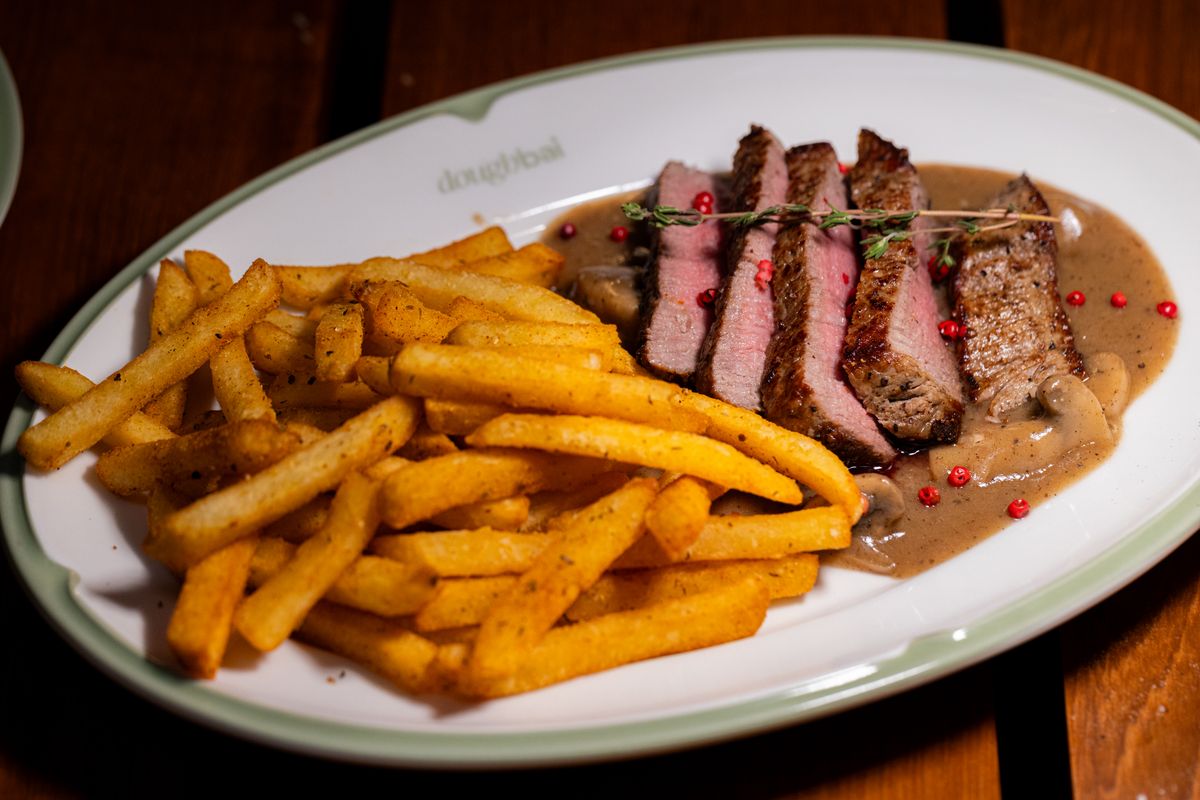
The two rules that make steak frites bistro-grade
Every restaurant version of this dish comes down to two rules. First: fries get double-fried — once low to cook the interior, once hot to crisp the outside. Second: steak gets butter-basted at the end, not throughout. Follow those and you’re eating what people fly to Paris for. Skip either and you’ve made steak and fries — a different meal.
The double-fry is not tradition for tradition’s sake. The first fry at 325°F cooks the potato interior all the way through while gently gelatinizing the surface starches. The second fry at 375°F blasts moisture out of that surface and creates the shatter-crisp shell — a technique Serious Eats broke down in Kenji López-Alt’s foundational fries guide. Single-frying gives you either raw centers or greasy exteriors. Never both crisp and cooked.
Ingredients (serves 2 — scale by 1.5 for 3)
For the frites
| Ingredient | Amount | Notes |
|---|---|---|
| Russet potatoes | 1½ lb (2 large) | Idaho russets — Yukon Gold turn soggy |
| Neutral oil for frying | 6 cups | Peanut, canola or beef tallow (bistro-authentic) |
| Fine sea salt | To taste | Salted the instant they leave the oil |
For the steak
| Ingredient | Amount | Notes |
|---|---|---|
| Strip steaks (or ribeye, hanger, bavette) | 2 × 8 oz, 1-inch thick | Room-temp for 30 min before cooking |
| Kosher salt | 2 tsp total | Salt 40 min ahead or immediately before |
| Coarse black pepper | 1 tsp | Cracked, not ground |
| Neutral oil | 1 tbsp | For the pan |
| Unsalted butter | 3 tbsp | Added at the end for basting |
| Garlic cloves, smashed | 3 | Skin on is fine |
| Fresh thyme or rosemary | 4 sprigs | Whole sprigs for the baste |
For a 3-ingredient bistro sauce (choose one)
| Sauce | Ingredients | Assembly |
|---|---|---|
| Maître d’hôtel butter | 4 tbsp softened butter + 1 tbsp minced parsley + 1 tsp lemon juice | Mash together, dollop on hot steak |
| Sauce au poivre (peppercorn) | 2 tbsp crushed peppercorns + ¼ cup cognac + ½ cup heavy cream | Deglaze pan, reduce 3 min, whisk cream in |
| Red wine reduction | 1 cup dry red wine + 2 tbsp shallots + 2 tbsp butter | Sauté shallot, reduce wine by half, mount with butter |
Step-by-step (25 minutes active)
- Cut and soak the fries (30 min hands-off). Peel the potatoes (or don’t — French bistros usually leave skins on for texture). Cut into ¼-inch batons, 3 inches long. Soak in cold water 30 minutes minimum, an hour ideal. This pulls surface starch out and is the reason your fries won’t stick together in the fryer.
- Dry the fries thoroughly (2 min). Drain, then spread on paper towels or a clean kitchen towel. Pat aggressively dry — water hitting hot oil is dangerous, and any moisture left on the surface prevents crisping.
- First fry at 325°F (5–6 min). Heat oil in a Dutch oven or deep skillet to 325°F (use a thermometer — this is not eyeballable). Fry the potatoes in 2 batches for 5–6 minutes each, until soft but pale — they should not brown. Drain on paper towels. Cool at room temp 10 minutes minimum. This can be done up to 3 hours ahead.
- Pat and season the steaks (2 min). Pat the steaks bone-dry with paper towels. Salt both sides heavily with kosher salt. Sit at room temp while you finish the fries.
- Second fry at 375°F (3 min). Bring oil up to 375°F. Fry the blanched potatoes in 2 batches for 3 minutes, until deep golden and shatter-crisp. Transfer to a bowl lined with paper towel, salt immediately with fine sea salt. Toss so every fry gets seasoned.
- Sear the steaks (6 min). Heat 1 tbsp oil in a cast-iron pan over high heat until smoking. Lay steaks in away from you. Do not move for 3 minutes. Flip once, cook 2 more minutes. Cracked pepper on the raw side now (never before searing — it burns).
- Butter-baste (60 sec). Reduce heat to medium. Add butter, smashed garlic, and thyme sprigs to the pan. Tilt the pan and spoon the foaming butter over the steaks continuously for 60 seconds. Pull steaks to a warm plate. Rest 5 minutes minimum — the whole point of resting is that the juice redistributes.
- Build sauce, plate, serve. While steaks rest, make one of the three sauces (see table). Slice steaks against the grain, plate with the fries piled next to them, sauce alongside in a small ramekin. Eat within 3 minutes — fries deflate as they cool.
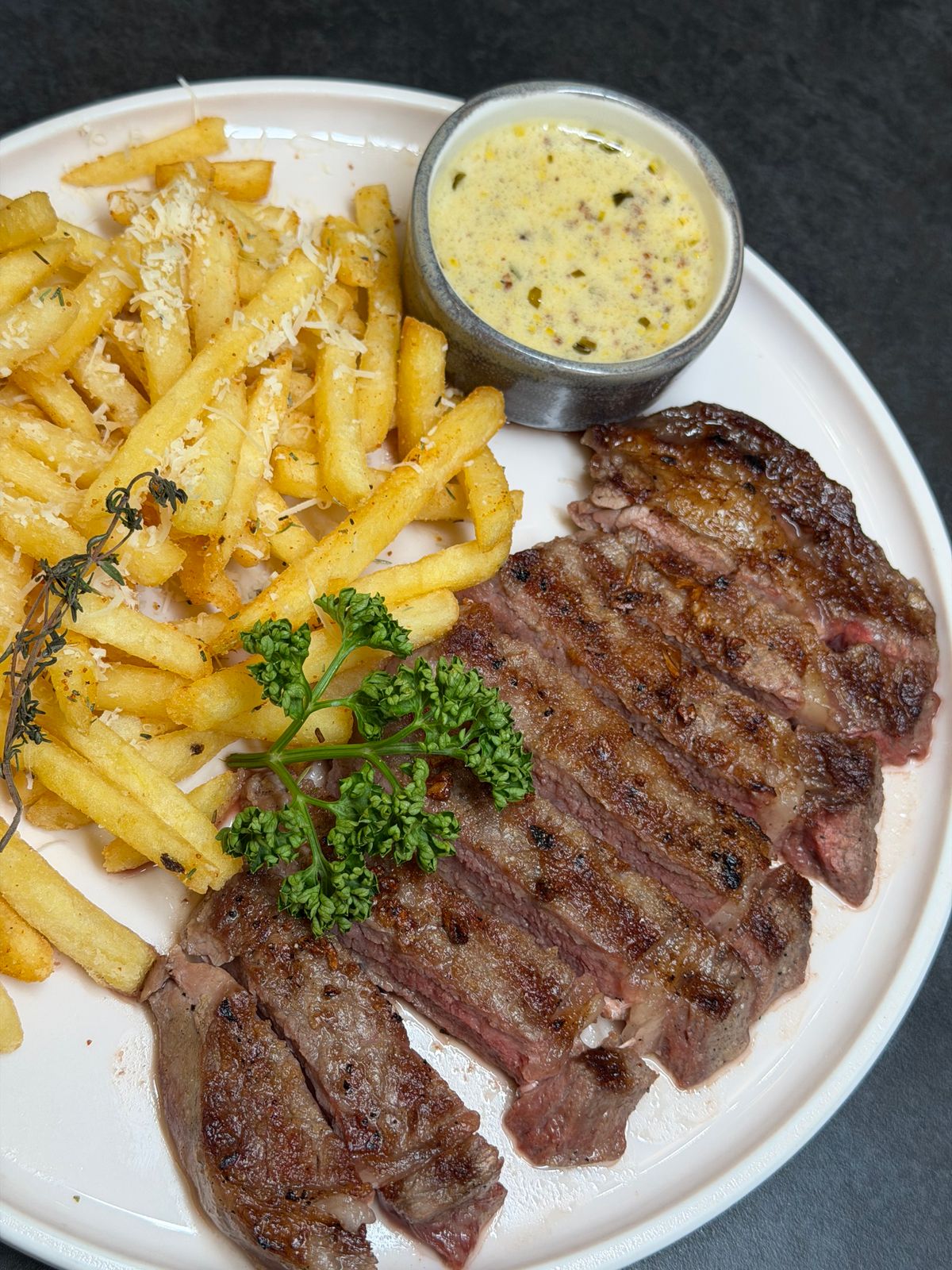
Watch a master French chef do it
Which steak cut belongs in a bistro version
Ask a French cook and you’ll get a different answer in every arrondissement. Traditional Parisian bistros favor onglet (hanger), bavette (flap) or entrecôte (ribeye). Belgian versions lean toward faux-filet (strip). What matters more than the specific cut is thickness: 1 inch minimum, 1½ inches ideal. Anything thinner cooks past medium-rare before the crust forms.
| Cut | Best for | Cook time (1-inch) | Notes |
|---|---|---|---|
| Strip / faux-filet | Easiest weeknight | 3 min per side + baste | Consistent, forgiving |
| Ribeye / entrecôte | Richest flavor | 3 min per side + baste | Trim excess fat for cleaner sear |
| Hanger / onglet | Most bistro-authentic | 2½ min per side | Must slice across the grain |
| Bavette / flap | Best flavor-to-price | 2 min per side | Very lean — do not overcook |
| Filet mignon | Not recommended | — | Too lean, too tender, wrong texture |
For a comparison of how the same cast-iron + baste method works on a different protein, see how we handle it in our 15-minute beef teriyaki — same sear-and-glaze logic, different sauce family.
The three mistakes that ruin bistro fries
Storage, reheating and the never-freeze rule
Fries do not survive as leftovers. They go from crisp to limp in about 20 minutes — the moisture from the interior migrates to the surface as they cool. If you must save them, spread on a wire rack in a 425°F oven for 4 minutes to revive them somewhat. It’s a Band-Aid, not a fix.
Steak leftovers work better. Slice, refrigerate 3 days, and serve cold over a green salad with the compound butter as a dressing base. Never microwave leftover steak — it goes grey and rubbery. If you must reheat, do it in a covered pan over low heat for 3 minutes with 1 tbsp of water in the bottom. The blanched (once-fried) potatoes actually freeze well between fries; portion into bags and go straight from freezer to the second fry.
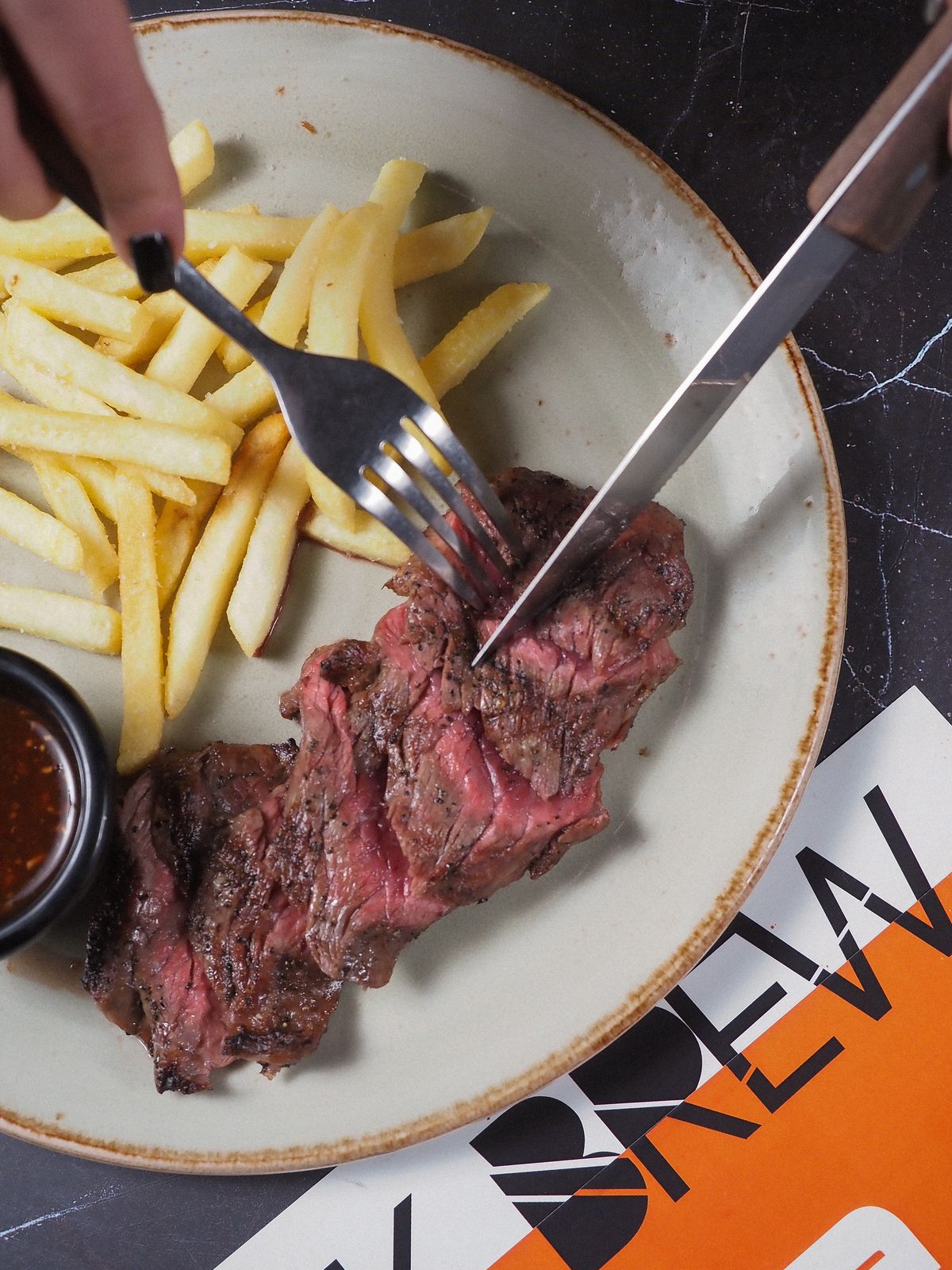
Real swaps and upgrades
No deep fryer? A 12-inch cast iron with 1½ inches of oil works. Air fryer fries won’t hit true bistro crisp — the surface never gets the oil bath needed for that shatter — but 400°F for 18 minutes with a mid-way shake gets you 80% there. Frozen fries can be double-fried too: 30 seconds at 325°F to hydrate slightly, then 3 minutes at 375°F. Nobody will notice.
For the steak, if all you have is a thin cut (½-inch), skip the basting step; it’ll overcook. Sear 90 seconds per side and go straight to the plate. Reverse-sear also works beautifully — 275°F oven to 115°F internal, then a 90-second-per-side finish in the cast iron. Beef tallow instead of neutral oil for the fries is the biggest single upgrade you can make. Some grocery butchers sell it; a quart lasts months in the freezer.
Common questions
Why are my fries soggy?
Three usual suspects. First, you didn’t soak long enough — 30 minutes minimum. Second, you didn’t dry them thoroughly — water hitting hot oil steams the surface instead of crisping it. Third, the oil temperature dropped during frying because you added too many at once. Fix any one and it usually solves it.
What temperature should the steak reach?
Pull from the pan at 130°F for medium-rare and rest to 135°F. Medium is 140°F pulled, 145°F rested. The USDA-safe minimum for whole cuts is 145°F — steak is a whole cut, not ground, so surface bacteria are killed by the sear even at rare. Use a digital thermometer; you cannot eyeball this reliably.
Can I use olive oil for the fries?
No. Olive oil has a smoke point around 375°F — right at the second-fry temperature — and it imparts a flavor that’s wrong for this dish. Use peanut, canola, sunflower, or beef tallow. Tallow is what French and Belgian bistros historically used and it’s coming back into vogue as the best-tasting option.
What’s the difference between steak frites and steak au poivre?
Steak frites is the dish (steak + fries). Steak au poivre is a specific preparation of the steak — crusted in crushed peppercorns and finished with a cognac cream sauce. You can absolutely serve steak au poivre with frites, and many bistros do; that’s just a specific form of steak frites. See our 30-minute beef and noodles for a completely different but equally comforting weeknight beef move.
Do the fries or the steak come first in timing?
Fries first — they’re forgiving and can wait 5 minutes on paper towel. Steak last, because it needs to hit the plate within 5 minutes of coming off the pan or it starts to cool. Start soaking fries 45 minutes before dinner, do the first fry 20 minutes before, sear the steak in the last 8 minutes, second-fry the fries in the last 4 minutes.
The bottom line
Forty minutes, two techniques doing all the work: double-fry potatoes so they crackle, butter-baste steak so it stays juicy. Everything else is timing and salt. The three-ingredient bistro sauce is optional — a fat pat of compound butter melting into a hot steak is arguably better anyway. Pour a glass of red, plate everything together, eat with your hands if you want (they do in Belgium). Pair with our Instant Pot beef stew for a weekend two-meat spread, or keep it solo bistro-style and put on Serge Gainsbourg.
Did You Try Our Recipe ?
Scrumptious
My husband (who is extremely picky) loved the liver & onions so much!! I didn’t have any beef broth or Sherry so I used about a tbl of Worcestershire and 1/4 c of white wine …..it was scrumptious
Response from MeatRecipesBox
Oh wow, I’m so happy to hear that!! 😍 I love that you made it work with what you had on hand — Worcestershire and white wine sound like a delicious twist. So glad your husband enjoyed it, especially being picky! Thank you for sharing your version, it makes me smile knowing it turned out scrumptious!
This was amazing
This recipe turned out really amazing! It’s juicy and spiced deliciously. I definitely would use less of the spicy pepper next time, but it really was delicious and I don’t think I’ll make chicken legs any other way from now on.!
Response from MeatRecipesBox
Thank you for taking the time to leave such a thoughtful review. I’m really glad to hear the recipe turned out juicy and full of flavor for you. That’s exactly what I was hoping for when putting it together. Good call on the spicy pepper as well. Adjusting the heat level to your own taste is always the best approach, and using a little less next time should make it just right for you. I really appreciate you trying the recipe and sharing your experience. It’s great to know it worked so well for you.
I Didn’t Expect This Cornbeef Hash Recipe to Taste This Good!!
One skillet. A handful of simple ingredients. Thirty minutes on the clock. And somehow… I ended up with the crispiest, most comforting cornbeef hash recipe I’ve made in years.
I wasn’t expecting much—just a quick, no-fuss meal. But that first bite? Crispy edges, tender potatoes, smoky corned beef, a little kick of pepper. It tasted like something straight off a cozy diner griddle.
Honestly, it caught me off guard—in the best way. Here’s why this simple skillet completely won me over.


