
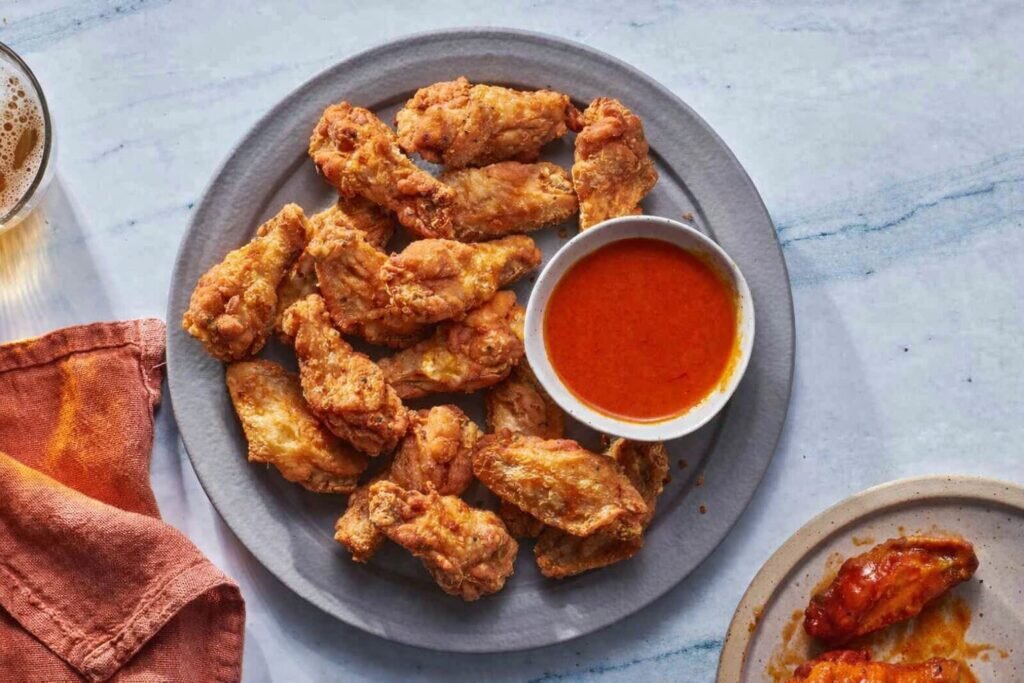
Fry chicken wings for 10-12 minutes at 375°F / 190°C, then give them a second 90-second fry at the same temperature for a shatteringly crisp skin. Total active frying time: roughly 12-14 minutes per batch.
That timing assumes room-temperature wings, 3 inches of oil in a heavy pot, and batches of 6-8 pieces. Deviate from any of those variables and your cook time shifts — the table below breaks it down.
Key Takeaways
- Deep-fry at 375°F (190°C) for 10-12 minutes, then re-fry 90 seconds for shatter-crisp skin.
- The double-fry technique holds crunch for 20+ minutes vs 8-10 minutes for single-fried wings.
- Internal temperature must hit 165°F (74°C) per USDA safe cooking guidelines.
- Batches of 6-8 pieces prevent the oil from dropping below 340°F, the threshold where wings absorb oil.
How Long to Fry Wings — The Full Breakdown
Food science: The first fry cooks the meat and renders fat; the second crisps the exterior by driving out residual surface moisture. Two shorter phases outperform one long fry every time.
The Double-Fry Technique
Heat oil to 375°F / 190°C in a Dutch oven or heavy-bottomed pot. The oil temperature will drop to 350-365°F once cold wings hit the surface — that initial drop is normal and actually helps the interior cook through before the exterior over-browns.
Fry 6-8 wings per batch for 10-12 minutes. Wings float to the surface when the moisture inside has largely evaporated from the skin — a reliable visual cue that the first fry is nearly done.
Pull them to a wire rack, let the oil climb back to 375°F, then return the wings for a final 90-second crisp.
Batch Size Controls Cook Time
Six to eight wings per batch is the sweet spot for a 5-quart pot. Any more and the oil drops below the 340°F absorption threshold, where wings soak up oil instead of frying in it.
Tip: Below 290°F oil absorption spikes; above 365°F oil actually renders out of the wing during the finish fry.
Quick Reference: Cook Time by Method
| Method | Oil Temp | First Fry | Second Fry | Total | Result |
|---|---|---|---|---|---|
| Deep fry (standard) | 375°F / 190°C | 10-12 min | 90 sec | ~14 min | Crisp, juicy |
| Deep fry (large batch) | 375°F / 190°C | 12-14 min | 90 sec | ~16 min | Even cook |
| Shallow fry (1″ oil) | 350°F / 177°C | 7-8 min/side | — | ~16 min | Less oil used |
| Air fryer | 400°F / 204°C | 22-25 min | — | ~25 min | Lower fat |
Free printable
Get every time and temperature on one sheet
The 3-page Meat Temp & Timing Cheat Sheet: internal temperatures, cook times for 30 cuts, resting and storage. Print it once, stop searching.
You’ll also get occasional recipes by email. Unsubscribe anytime. Privacy policy.
Almost there: check your inbox.
Click the confirmation link and the PDF downloads right away.
Deep Frying (Best Results)
The standard 375°F, 10-12 minute first fry followed by a 90-second second fry produces the crispest exterior with the juiciest meat. Everything else on this list is a tradeoff.
Shallow Frying
Use about 1 inch of oil at 350°F / 177°C. Cook wings 7-8 minutes per side, flipping once. This method uses less oil but requires attention — the exposed top half doesn’t cook until you flip, so timing per side matters more than total time.
Air Fryer
Set to 400°F / 204°C and cook 22-25 minutes, shaking the basket halfway through. The skin won’t reach the same level of Maillard browning as oil-fried wings because circulating air transfers heat less efficiently than submerged oil.
Tossing wings in a light coat of baking powder before air frying helps compensate — the alkaline surface accelerates browning.
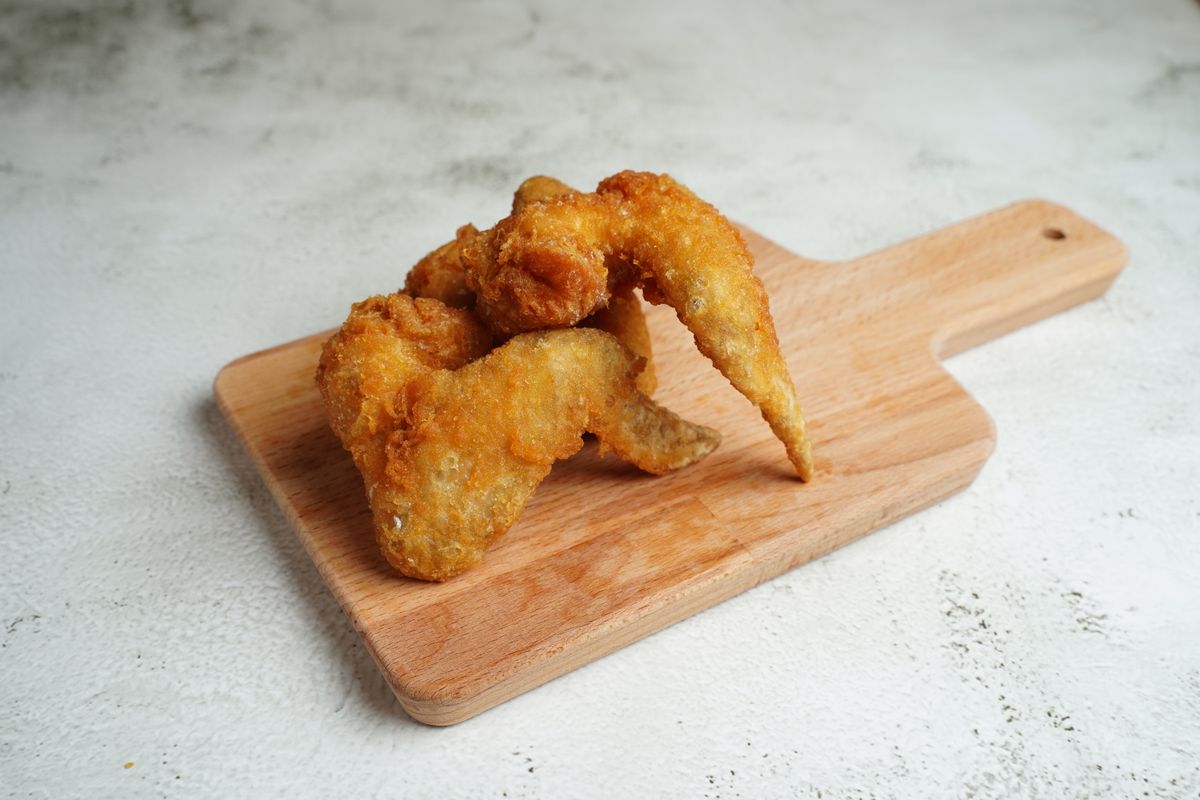
Wings resting between the first and second fry — photo via Pexels.
How to Deep Fry Chicken Wings — Step by Step
Food science: Baking powder is slightly alkaline. Raising the skin’s surface pH breaks peptide bonds and accelerates the Maillard reaction, producing measurably crispier wings.
- Prep the wings. Pat each piece with paper towels until no surface moisture remains. Wet skin causes oil splatter and prevents crisping.
- Season and rest. Toss wings with kosher salt, black pepper, and 2 teaspoons of baking powder per pound. Rest uncovered in the fridge for 30 minutes if time allows.
- Heat the oil. Heat oil to 375°F / 190°C in a Dutch oven. Use a clipped deep-fry thermometer. Peanut, vegetable, or avocado oil all work.
- First fry, 10-12 minutes. Lower 6-8 wings into the oil. Maintain heat between 350-365°F during cooking. Wings are done when they float and the skin turns deep golden.
- Rest, then double-fry 90 seconds. Transfer wings to a wire rack. Let oil return to 375°F, then drop the wings back in for a final 90-second crisp.
- Check internal temp. Insert an instant-read thermometer into the thickest part of a drumette — you need 165°F / 74°C minimum per USDA safe cooking guidelines.
From my kitchen: I’ve found that the 90-second second fry makes a measurable difference — single-fried wings lose crunch in 8-10 minutes, double-fried wings hold texture for 20+ minutes.
Pro Tips for Crispier Fried Wings
Manage Batch Size Ruthlessly
Adding too many wings at once drops oil temperature below 340°F, the point where wings absorb oil instead of frying in it. Stick to 6-8 pieces per batch in a 5-quart pot.
If your chicken wing frying time and temperature results feel inconsistent, batch size is almost always the culprit.
Use a Spider Strainer, Not Tongs
A spider strainer works better than tongs for lowering and retrieving wings. It disturbs the oil less and keeps splatter contained.
Compare With Oven Baking If You’re Curious
Deep frying wins on texture, but if you want a lower-effort alternative, our full baked wings temperature guide covers the trade-offs.
Common Mistakes to Avoid
Frying at the wrong temperature. Below 340°F, wings absorb oil and turn greasy. Above 390°F, the exterior chars before the interior reaches 165°F / 74°C. Keep a thermometer in the oil at all times.
Skipping the double fry. A single long fry dries out the meat trying to crisp the skin. Two shorter phases — a cook phase and a crisp phase — solve both problems independently.
Saucing too early. Buffalo sauce softens fried skin within about 3 minutes of contact. Toss wings in sauce right before they hit the plate, not while you’re still frying the next batch.
Wing Consumption & Frying Trends
Wings are having their biggest year on record. Americans were projected to eat 1.48 billion wings during Super Bowl LX alone — 10 million more than the previous year.
Chicken wing units sold nationwide climbed 19.8% year-over-year across the four-week playoff window, with dollar sales up 11.4%.
Timing tip: Retailers move more wings mid-January through Super Bowl weekend, which typically means fresher inventory and better prices for practice batches.
Frequently Asked Questions
How do I know when fried wings are done without a thermometer?
Wings float and the skin turns deep golden-brown when nearly done. Pierce the thickest part of a drumette — juices should run clear. A thermometer reading 165°F / 74°C is still the only reliable confirmation.
Can I fry wings straight from frozen?
You can, but add 4-5 minutes to total fry time and expect significant oil splatter from ice crystals. Thawing overnight in the refrigerator produces safer, more predictable results.
What oil temperature is best for frying wings?
Start at 375°F / 190°C. The oil naturally drops to 350-365°F when you add cold wings — that range is ideal for Maillard browning, which peaks between 330-390°F.
How long to fry wings in a deep fryer vs a pot?
Same timing: 10-12 minutes plus a 90-second crisp fry. Deep fryers recover temperature faster, so you may shave 1-2 minutes off in a dedicated fryer.
Does wing size affect frying time?
Yes. Jumbo flats can take 13-14 minutes on the first fry; small drumettes may finish in 9. Use internal temperature (165°F / 74°C), not time alone, as your final check.
Save This Wing Frying Guide
Fry at 375°F, double-fry for crunch, check for 165°F internal — pin it so you have the timing dialed in every batch.
Pin This RecipeDid You Try Our Recipe ?
Chicken hears and gizzards
I would love you to send me the recipe please. I have no printer to print it off. [email protected]
Response from MeatRecipesBox
Hi Sharon, thank you so much for your kind words! I’ve just sent the full recipe to your inbox. Enjoy, and let me know how it turns out! 😊
Scrumptious
My husband (who is extremely picky) loved the liver & onions so much!! I didn’t have any beef broth or Sherry so I used about a tbl of Worcestershire and 1/4 c of white wine …..it was scrumptious
Response from MeatRecipesBox
Oh wow, I’m so happy to hear that!! 😍 I love that you made it work with what you had on hand — Worcestershire and white wine sound like a delicious twist. So glad your husband enjoyed it, especially being picky! Thank you for sharing your version, it makes me smile knowing it turned out scrumptious!
This was amazing
This recipe turned out really amazing! It’s juicy and spiced deliciously. I definitely would use less of the spicy pepper next time, but it really was delicious and I don’t think I’ll make chicken legs any other way from now on.!
Response from MeatRecipesBox
Thank you for taking the time to leave such a thoughtful review. I’m really glad to hear the recipe turned out juicy and full of flavor for you. That’s exactly what I was hoping for when putting it together. Good call on the spicy pepper as well. Adjusting the heat level to your own taste is always the best approach, and using a little less next time should make it just right for you. I really appreciate you trying the recipe and sharing your experience. It’s great to know it worked so well for you.
I Didn’t Expect This Cornbeef Hash Recipe to Taste This Good!!
One skillet. A handful of simple ingredients. Thirty minutes on the clock. And somehow… I ended up with the crispiest, most comforting cornbeef hash recipe I’ve made in years.
I wasn’t expecting much—just a quick, no-fuss meal. But that first bite? Crispy edges, tender potatoes, smoky corned beef, a little kick of pepper. It tasted like something straight off a cozy diner griddle.
Honestly, it caught me off guard—in the best way. Here’s why this simple skillet completely won me over.


