

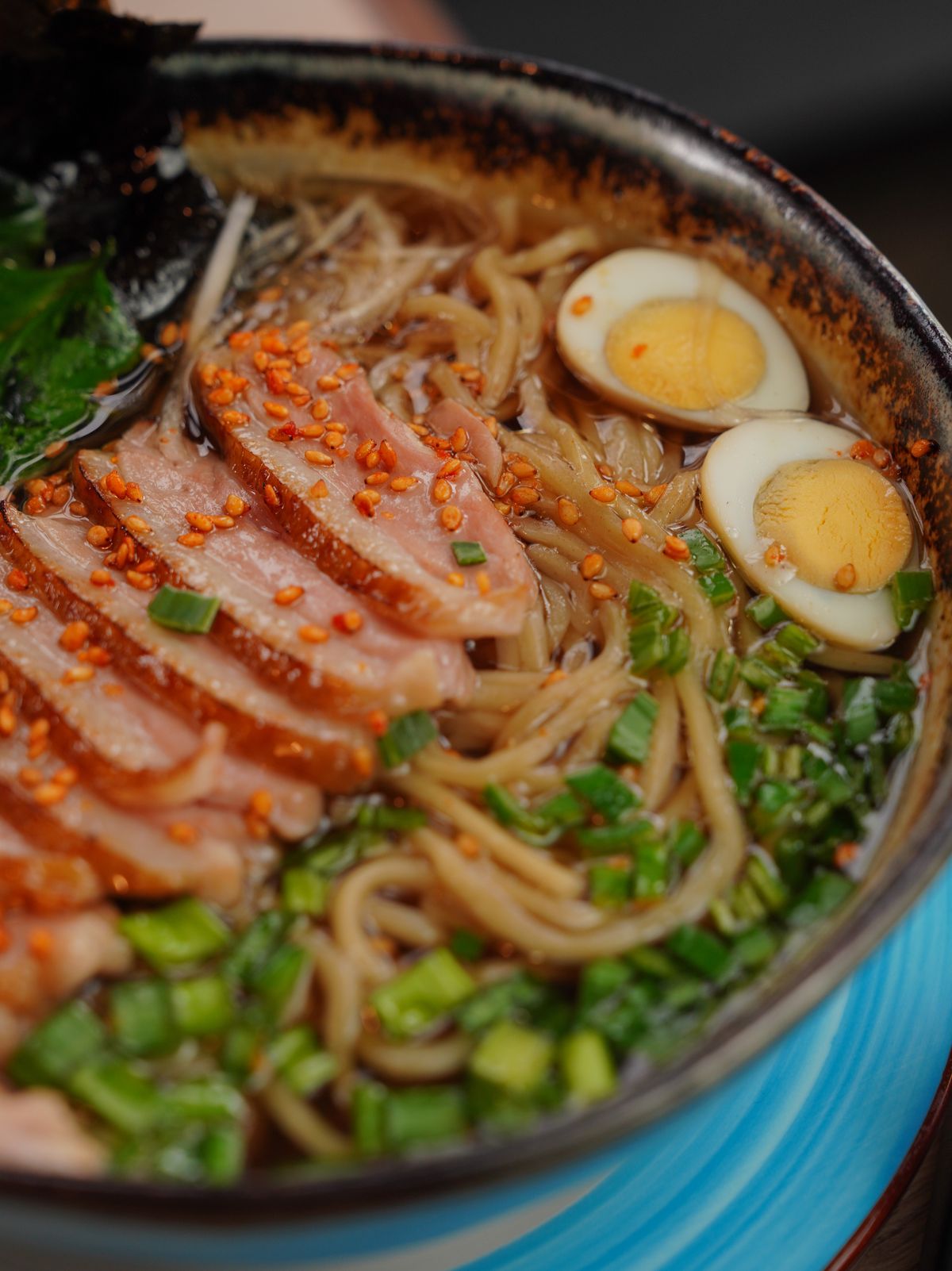
Why 60 minutes works when shops take 12+ hours
Shop tonkotsu and gyukotsu broths simmer 10–18 hours to emulsify collagen and marrow into that iconic milky-opaque broth. That’s not what you’re making at home. This is a clear-style beef ramen — closer to Tokyo shoyu than Kyushu tonkotsu — where roasting the bones at 450°F does the flavor-building work in 25 minutes that raw bones need hours to produce. Serious Eats documents this shortcut in their shoyu ramen guide.
The other trick is separating the broth from the tare (that’s the concentrated seasoning base in the bottom of every ramen bowl). Shops make broth once a day and season it per bowl. You do the same: an unsalted broth simmering on the stove, and 3 tablespoons of tare whisked into each bowl. It’s how the same broth becomes shoyu, miso, or shio ramen depending on what tare you add.
Broth-time comparison
| Method | Active | Total | Result |
|---|---|---|---|
| This recipe (roasted bones + broth boost) | 15 min | 60 min | Deep, clean, restaurant-adjacent |
| Traditional gyukotsu (beef bone) | 30 min | 12–18 h | Milky, gelatinous, top-tier |
| Store-bought broth + tare only | 10 min | 25 min | Good weeknight; missing depth |
| Instant Pot beef broth (from raw bones) | 15 min | 2 h 15 min | Solid — needs less time than stovetop, more than roasted |
| Packet ramen with beef strips | 5 min | 10 min | College-dorm tier |
Ingredients (serves 4)
For the broth
| Ingredient | Amount | Notes |
|---|---|---|
| Beef marrow bones | 1 lb | Ask the butcher; often free or near-free |
| Beef short ribs (bone-in) | 1 lb | These become both broth and topping |
| Yellow onion, halved | 1 large | Skin on — it adds color |
| Garlic, smashed | 1 whole head | Cut in half across the equator |
| Fresh ginger, sliced | 2-inch piece | Unpeeled is fine |
| Low-sodium beef broth | 6 cups | Kettle & Fire or Better Than Bouillon |
| Dried shiitake mushrooms | 4 (optional but recommended) | The umami backbone |
| Kombu (dried kelp) | 1 4-inch piece | Adds glutamates; skip if you must |
For the tare + toppings
| Ingredient | Amount | Notes |
|---|---|---|
| White or yellow miso paste | 4 tbsp total (1 tbsp per bowl) | Skip for pure shoyu style |
| Soy sauce | ½ cup total (2 tbsp per bowl) | Regular, not low-sodium |
| Mirin | 2 tbsp | Or 1 tbsp sugar + 1 tbsp water |
| Toasted sesame oil | 4 tsp (1 tsp per bowl) | Off-heat, into the bowl only |
| Fresh ramen noodles | 4 portions (~14 oz total) | Sun brand or Sanwa; instant ramen noodles work in a pinch — see note below |
| Sirloin steak | 12 oz, ½-inch thick | Seared and thin-sliced across the grain |
| Soft-boiled eggs | 4 | 6½ minutes exactly for jammy yolks |
| Scallions, sliced thin | 4 | Both whites and greens |
| Nori sheets, halved | 2 | Toasted lightly if untoasted |
| Chili crisp (optional) | To taste | Fly By Jing or Lao Gan Ma |
Step-by-step (15 minutes active, 45 hands-off)
- Roast the bones (25 min). Preheat oven to 450°F. Arrange marrow bones, short ribs, halved onion and halved garlic head cut-side-up on a sheet pan. Roast 20–25 minutes until everything is deeply browned. This is the entire flavor of the broth — not optional.
- Start the broth (5 min). Move everything from the sheet pan to a 6-quart stockpot. Pour ½ cup water on the sheet pan and scrape up every stuck bit — that fond goes into the pot. Add 6 cups beef broth, ginger, shiitake, kombu. Bring to a simmer.
- Simmer (30 min). Keep it at a low simmer, uncovered. Do not boil hard or the broth turns cloudy and greasy. Skim any grey scum from the top with a spoon in the first 5 minutes. Pull the kombu after 20 minutes so it doesn’t go bitter.
- Sear and rest the steak (6 min). Salt the sirloin 10 minutes ahead. Get a cast-iron pan smoking hot, add 1 tsp neutral oil, sear 2 minutes per side to a USDA-safe 145°F for medium-rare. Rest on a board 5 minutes, then slice thin across the grain.
- Soft-boil the eggs (7 min). Bring water to a rolling boil. Lower eggs in gently, boil exactly 6½ minutes, transfer to an ice bath 2 minutes. Peel under cold running water. Halve just before serving.
- Cook the noodles (2–4 min). Fresh ramen: 2 minutes in a separate pot of unsalted boiling water. Instant ramen bricks: 3 minutes, then drain. Never cook noodles in the broth — they release starch and cloud everything.
- Build each bowl (2 min). In each warmed bowl, whisk 1 tbsp miso + 2 tbsp soy + ½ tbsp mirin + 1 tsp sesame oil (that’s your per-bowl tare). Add noodles. Ladle 1½ cups of strained hot broth over the top — the tare dissolves as it hits. Top with sirloin slices, a halved egg, scallions and a piece of nori. Serve immediately.
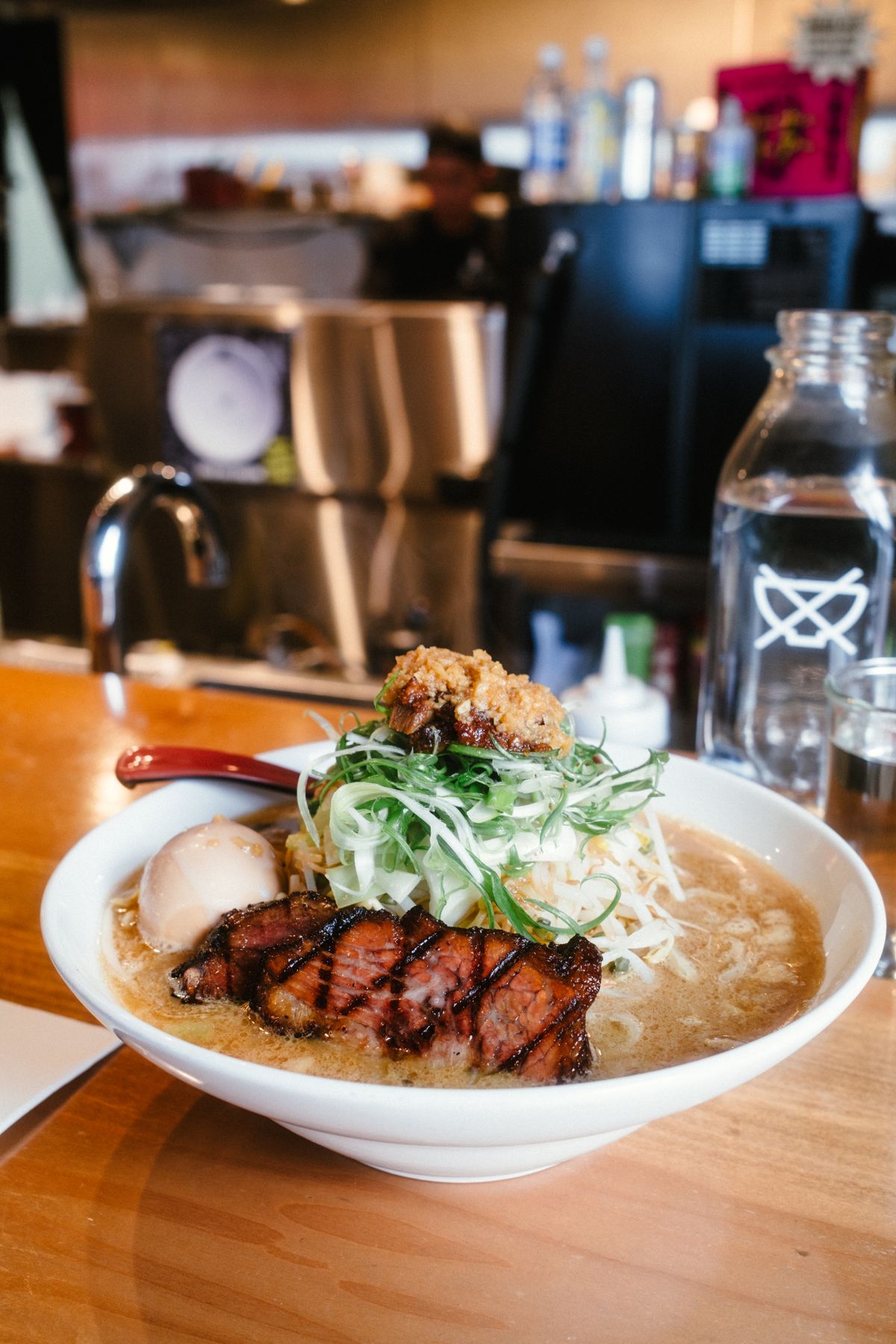
Watch a real beef ramen come together
The tare is the whole game
Tare (pronounced tah-ray) is what turns unseasoned bone broth into ramen. Every good bowl has this two-part structure: unsalted broth from the stockpot, seasoned per-bowl with a concentrated sauce. It’s why the same batch of broth can be shoyu, shio, miso or spicy — you’re just changing the tare.
| Style | Tare per bowl |
|---|---|
| Shoyu (soy) — the default here | 2 tbsp soy sauce, ½ tbsp mirin, 1 tsp sesame oil |
| Shio (salt) | 1 tsp fine sea salt, ½ tsp sake, 1 tsp sesame oil |
| Miso | 1½ tbsp white miso, 1 tbsp soy, 1 tsp sesame oil, ½ tsp doubanjiang |
| Spicy tantan-inspired | 1 tbsp chili crisp, 1 tbsp soy, 1 tsp black vinegar, 1 tsp sesame oil |
This is also why the same base recipe can pivot to chicken or pork — swap the bones and toppings but keep the tare framework identical. For a faster weeknight version with the same building-block logic, our 15-minute chicken noodles recipe uses store-bought broth and skips the roast.
The three mistakes that ruin homemade ramen
Storage, freezing and the leftover trick
The broth freezes beautifully for 3 months in quart containers. Cool completely, skim any fat that sets on top (save it — schmaltz for the next bowl), then freeze flat in zip-top bags. Thaw in the fridge overnight or in a pot on low heat. The tare mixed together separately keeps refrigerated for 2 weeks.
The leftover trick nobody talks about: shred any remaining short-rib meat from the broth-building step and refrigerate it in a container with a spoonful of tare. That becomes tomorrow’s topping — bright, tender, already seasoned. Never serve noodles as leftovers though; they turn to paste in the fridge. Cook only what you’ll eat in one sitting.
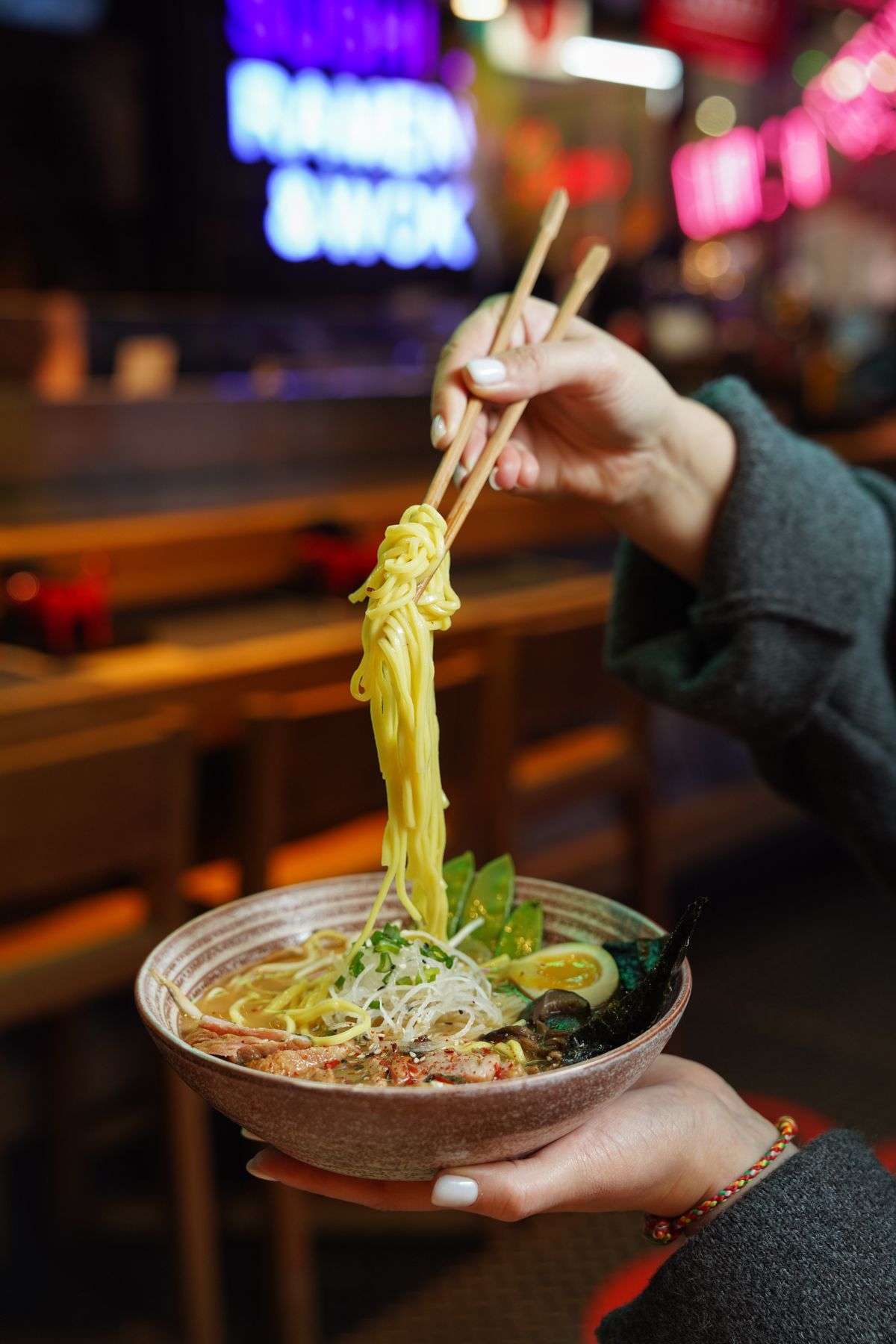
Real swaps and upgrades
No fresh ramen noodles? A brick of instant ramen — Nissin, Maruchan, whatever — works if you throw away the flavor packet. The alkaline mineral water in the dough is what makes them ramen. Regular pasta or udon does not substitute; the texture is entirely wrong. Fresh noodles freeze well, so buy extra when you see them.
For a richer bowl, add 2 tbsp of the strained fat you skimmed off the broth into each bowl with the tare — restaurants call this aroma oil. A drizzle of the meat glaze from our beef teriyaki with Japanese sauce makes a great extra glaze on the sliced sirloin. For heat, chili crisp goes on last so it floats visibly on top. Corn kernels, bamboo shoots and bean sprouts all belong — add them raw or briefly blanched.
Common questions
Can I use store-bought beef broth only, no bones?
Yes, and it still works — skip step 1 entirely and start at step 2 with just aromatics and broth. You lose about 30% of the flavor depth. Boost it back with 2 extra dried shiitake and 1 tsp of fish sauce added to the pot. Ready in 25 minutes instead of 60.
What if I can’t find fresh ramen noodles?
Instant ramen bricks (throw out the seasoning packet) are the standard sub — they’re the same alkaline noodle, just dried. Cook 3 minutes in unsalted water. If you have a Japanese grocery nearby, Sun brand or Sanwa fresh noodles refrigerate for weeks unopened. Frozen fresh ramen from H-Mart works and thaws in 2 minutes of boiling.
Why is my broth cloudy?
Almost always from boiling too hard. Cloudy broth isn’t ruined — it’s actually closer to tonkotsu style — but if you wanted clear, drop the heat and let it settle uncovered for 20 minutes. Skim any fat that rises. Straining through a coffee filter pulls the last of the sediment out.
Can I use ground beef instead?
You wouldn’t for the topping — the texture is wrong for ramen. But sautéed ground beef with garlic and gochujang makes a legitimate spicy ramen topping (this is basically the Korean tantan-men move). Skip the sirloin step, brown 8 oz ground beef with 1 tbsp gochujang, and use that on top. Same flavor family as our Instant Pot beef stew broth-building approach.
What makes ramen noodles different from regular noodles?
Alkaline salts — sodium carbonate or potassium carbonate — added to the dough. That’s what gives ramen noodles their yellow color, springy chew and slightly funky flavor. Wheat noodles without alkalinity are just wheat noodles; they’ll go limp in hot broth. This is why substituting spaghetti never actually works.
The bottom line
Sixty minutes, one shortcut you take (store-bought base broth as backbone) and one you don’t (roasting the bones and short ribs). Build tare separately from broth so the flavor stays yours to control. Cook noodles apart, sesame oil off-heat, serve immediately. Skip any of these and you’ve made beef noodle soup — which is fine, but it isn’t ramen. Pair with a side of our 30-minute beef and noodles if you’re feeding a crowd, or eat this one solo, straight from a big bowl, on a rainy Wednesday.
Did You Try Our Recipe ?
Chicken hears and gizzards
I would love you to send me the recipe please. I have no printer to print it off. [email protected]
Response from MeatRecipesBox
Hi Sharon, thank you so much for your kind words! I’ve just sent the full recipe to your inbox. Enjoy, and let me know how it turns out! 😊
Scrumptious
My husband (who is extremely picky) loved the liver & onions so much!! I didn’t have any beef broth or Sherry so I used about a tbl of Worcestershire and 1/4 c of white wine …..it was scrumptious
Response from MeatRecipesBox
Oh wow, I’m so happy to hear that!! 😍 I love that you made it work with what you had on hand — Worcestershire and white wine sound like a delicious twist. So glad your husband enjoyed it, especially being picky! Thank you for sharing your version, it makes me smile knowing it turned out scrumptious!
This was amazing
This recipe turned out really amazing! It’s juicy and spiced deliciously. I definitely would use less of the spicy pepper next time, but it really was delicious and I don’t think I’ll make chicken legs any other way from now on.!
Response from MeatRecipesBox
Thank you for taking the time to leave such a thoughtful review. I’m really glad to hear the recipe turned out juicy and full of flavor for you. That’s exactly what I was hoping for when putting it together. Good call on the spicy pepper as well. Adjusting the heat level to your own taste is always the best approach, and using a little less next time should make it just right for you. I really appreciate you trying the recipe and sharing your experience. It’s great to know it worked so well for you.
I Didn’t Expect This Cornbeef Hash Recipe to Taste This Good!!
One skillet. A handful of simple ingredients. Thirty minutes on the clock. And somehow… I ended up with the crispiest, most comforting cornbeef hash recipe I’ve made in years.
I wasn’t expecting much—just a quick, no-fuss meal. But that first bite? Crispy edges, tender potatoes, smoky corned beef, a little kick of pepper. It tasted like something straight off a cozy diner griddle.
Honestly, it caught me off guard—in the best way. Here’s why this simple skillet completely won me over.


